
ENT Endoscopy
Flexible endoscopic examination of the nose, sinuses, throat, and voice box when clinically indicated
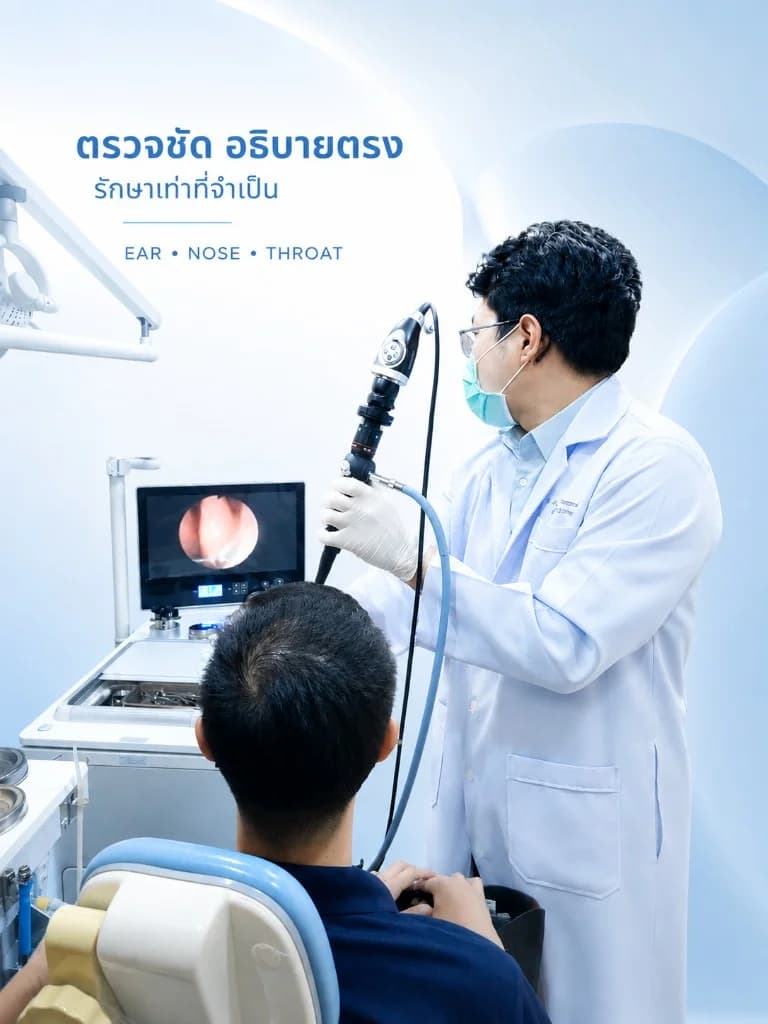

Medically reviewed by a board-certified ENT specialist
- Author:
- Dr. Poj Pinyopornpanish — Otolaryngologist · Thai Board of Otolaryngology
- Medical reviewer:
- Dr. Poj Pinyopornpanish — Otolaryngologist · Thai Board of Otolaryngology
- Reviewed on:
- Last updated:
- Estimated reading time: 5 min
Overview
What is ENT endoscopy?
Flexible nasal endoscopy uses a thin, flexible scope to examine the nasal passages, nasopharynx, throat, or larynx (voice box) through the nose or mouth. It allows direct visualisation of structures not clearly seen on routine examination.
The procedure is performed in clinic, usually with local anaesthetic spray to the nose or throat. It typically takes about 5–15 minutes depending on the extent of examination.
Not every symptom requires endoscopy. Your doctor recommends it when indicated — for example, persistent nasal congestion, recurrent sinus symptoms, hoarseness, or suspected neck findings. Results guide management planning alongside history and examination.
Symptoms
When endoscopy may be considered
Endoscopy may be recommended when symptoms or examination suggest internal assessment is needed:
Persistent nasal congestion, discharge, or recurrent sinusitis
Difficulty breathing through the nose or chronic mouth breathing
Hoarseness, throat irritation, or persistent sore throat
Swallowing difficulty or a sensation of something stuck in the throat
Snoring or suspected laryngeal problems
Neck lumps or abnormalities needing assessment
Symptoms not improving with prior treatment and further evaluation is needed
Possible causes
What endoscopy helps assess
Endoscopy visualises structure and abnormalities — it does not identify every cause alone.
Rhinitis or sinusitis
Assesses swelling, discharge, or sinus ostium blockage — helpful in chronic disease.
Enlarged inferior turbinates
Inferior turbinate hypertrophy may cause blockage — endoscopy helps confirm.
Enlarged adenoids
Tissue at the back of the nose, common in children — may relate to mouth breathing or snoring.
Larynx and vocal cords
Examines the larynx when hoarseness or throat symptoms are present. Images or video may be recorded when needed.
Neck or throat abnormalities
Visualises the throat and larynx when lumps or inflammation are suspected.
Foreign material or inflammation
In some cases, retained material or inflammation needs direct visual assessment.
When to seek assessment
When to see an ENT specialist
Consider assessment if you have any of the following:
Persistent nasal or sinus symptoms not improving
Hoarseness or throat irritation lasting more than 2–3 weeks
Swallowing difficulty or a lump-in-throat sensation
Persistent snoring or mouth breathing
Your doctor has recommended endoscopy for structural assessment
You want to understand the procedure and what findings may mean
Diagnosis
How endoscopy is performed
Assessment begins with history and basic ear, nose, and throat examination. When indicated, your doctor explains the endoscopy steps.
Before the scope, local anaesthetic may be applied to the nose or throat. A flexible scope is passed through the nostril or mouth to examine the nasal cavity, nasopharynx, throat, or larynx as needed. Images may be recorded to explain findings or for follow-up.
After the procedure, your doctor summarises findings and next steps. Further tests — such as CT imaging or allergy testing — may be recommended based on what is seen.
Treatment
Management after endoscopy
Care depends on findings. Not every abnormality requires surgery.
Cause-specific treatment
Medication, nasal irrigation, or allergy management when inflammation or blockage is found.
Monitoring
Some findings may be followed with repeat examination or endoscopy at set intervals.
Further investigation
CT imaging, hearing tests, or other assessments may be recommended when needed.
Surgery or procedures
May be considered when structural findings require treatment and other options are insufficient, according to indications.
Voice care
When laryngeal problems are found, voice rest, medication, or laryngology referral may be advised as appropriate.
Why RAJVITHI CLINIC
Why choose RAJVITHI CLINIC
Endoscopy is a core procedure in otolaryngology (ENT) practice.
ENT specialist experienced in nasal and laryngeal endoscopy
Clear explanation of procedure and findings in plain language
Endoscopy when clinically indicated — not for every symptom
Evidence-based, individualized investigation planning
Image or video recording when helpful for explanation and follow-up
FAQ
Questions patients often ask
Is endoscopy painful?
Local anaesthetic is usually used. You may feel mild discomfort or an urge to swallow. Discomfort typically resolves quickly. Your doctor explains the steps.
How long does it take?
Usually about 5–15 minutes depending on the extent of examination, including anaesthetic preparation.
Do I need to fast before endoscopy?
Usually not for clinic nasal or laryngeal endoscopy. Your doctor will advise if special preparation is required.
Can children have endoscopy?
Yes when indicated. Your doctor assesses cooperation and explains to parents or caregivers.
Can endoscopy replace CT scanning?
No. Endoscopy shows surface structures directly; CT shows deeper anatomy and bone. Your doctor selects tests as needed.
Does everyone with nasal congestion need endoscopy?
No. It is performed when indicated — for example, persistent symptoms, recurrent sinus disease, or suspected structural problems.
Can I drive afterwards?
Usually yes after endoscopy with local anaesthetic alone. If additional sedation is used, your doctor will advise.
Do I need an appointment?
Yes. Appointments are recommended, especially if endoscopy is planned on the same visit.
Where is RAJVITHI CLINIC?
1st Floor, MD Boutique Hotel, 18 Rajvithi Road, Chiang Mai
Is English consultation available?
Yes. The clinic sees international patients and English consultation is available.
References
Related guidelines and patient resources
The sources below are recognized international guidelines and patient-education resources for general learning. They are not individualized medical advice.
European Position Paper on Rhinosinusitis and Nasal Polyps (EPOS)
European Rhinologic Society / EPOS
View source (European Rhinologic Society / EPOS)Patient information on nose and sinus conditions
AAO-HNS / ENThealth
View source (AAO-HNS / ENThealth)Patient education and clinical guidance in otolaryngology
American Academy of Otolaryngology–Head and Neck Surgery (AAO-HNS)
View source (American Academy of Otolaryngology–Head and Neck Surgery (AAO-HNS))Public ENT health information
ENThealth (AAO-HNS Foundation)
View source (ENThealth (AAO-HNS Foundation))
Educational information
Medical Disclaimer
This information is intended for educational purposes only and does not replace diagnosis or treatment by a qualified physician. If you have concerning symptoms, please consult an ENT specialist.
Related links
Learn more
Related clinic pages to help you explore conditions, services, and procedures.
Interested in ENT endoscopy?
Contact the clinic to book an appointment or ask preliminary questions. The doctor will assess whether endoscopy is appropriate for you.